.webp)


TLDR: The City of London hides a Roman gladiator arena eight metres underground, a 3rd-century temple of a mystery cult, a bombed-out church garden, and much more. All five entries in this guide are free.
The Square Mile has a habit of burying its most interesting things. Sometimes literally: two of the five places in this guide are underground. The others are tucked in courtyards and back streets that most people pass without stopping.
After several visits spent deliberately looking for what the City of London doesn't put on signboards, here's what I'd send someone who's already done the main attractions and wants to go deeper.
1. The Roman Amphitheatre

Most visitors to the City of London walk across the oval of dark paving stones in Guildhall Yard without understanding what they're standing on. That ring of stones marks the exact outer perimeter of London's only Roman amphitheatre - a structure built in AD 70 that could seat around 6,000 people and was used for gladiatorial contests, animal fights, public executions, and religious ceremonies.
The amphitheatre was discovered in 1988 during construction of the Guildhall Art Gallery, when archaeologists found something they'd been looking for for over a century. The preserved remains are displayed eight metres below the modern street in the gallery basement: original arena walls, a surviving section of the eastern entrance tunnel, and wooden drainage channels that lasted nearly 2,000 years in the waterlogged ground. Digital projections reconstruct the space around the fragments. It's one of the more quietly astonishing things you can do in London, and the entry is free.
Access is through the Guildhall Art Gallery on the eastern side of Guildhall Yard. Check opening times before visiting, as the gallery closes on Mondays and for private events.
Did you know? The amphitheatre was found inside the Roman city walls - unusual, since most Roman amphitheatres were built outside city boundaries. Archaeologists believe it was positioned near the military fort, which was also inside the walls. The streets surrounding Guildhall Yard still follow the oval outline of the arena above - the medieval city unconsciously organised itself around the shape of a building it had forgotten.
2. Guildhall Yard

The Roman Amphitheatre is the reason to descend into the Guildhall Art Gallery basement. But Guildhall Yard itself is worth spending time in above ground, and most visitors to the City pass it by entirely.
The Great Hall - England's third-largest medieval hall, dating from around 1411 - still stands at the north end of the yard, its stained glass windows and 29-metre roof intact despite the Great Fire and the Blitz. Entry is free on weekdays when no functions are running; it's one of the most impressive medieval civic interiors in the country and almost never crowded. The hall is still used for banquets, elections, and City ceremonies, which means you may occasionally arrive to find it closed - worth checking ahead.
The yard itself, with its curved dark-stone oval marking the amphitheatre below and the 15th-century stone walls around it, is somewhere to slow down. The contrast between the medieval architecture and the glass towers visible over the roofline tells the City's story more efficiently than most museum exhibits.
Did you know? Guildhall survived the Great Fire of 1666 - its stone structure resisted where the surrounding wooden buildings burned. The medieval crypt beneath is one of the largest surviving in London and is occasionally open for public tours.
3. London Mithraeum (Bloomberg SPACE)

In 1954, during the post-war rebuilding of the City, workers on a bomb site near Walbrook uncovered the near-complete footprint of a 3rd-century Roman temple dedicated to the god Mithras. The discovery attracted up to 30,000 visitors a day over a fortnight - queues stretched through the rubble of the surrounding bombsites - and became one of the most significant archaeological events in British history.
The temple was subsequently dismantled and moved 100 metres from its original location to make way for development. It sat, poorly reconstructed and largely unloved, on the roof of a car park for decades. When Bloomberg acquired the site in 2010 to build its European headquarters, the company committed to reinstating the temple in its original location. The London Mithraeum Bloomberg SPACE opened in November 2017 - the temple reconstructed seven metres below street level, at the original Roman ground floor, with the surviving stones in their correct positions and a sound-and-light installation that fills the dark space with chanting voices and shuffling sandals.
The experience is genuinely unsettling in the right way. Visitors descend to Roman ground level, stand in the darkness, and wait for the temple to emerge from it. The artefacts found during the subsequent 2010–2014 excavations - including over 400 fragments of Roman writing tablets, the largest and earliest collection of its kind found in Britain - are displayed in the floors above.
Entry is free. Opening hours are Tuesday to Saturday 10 AM–6 PM, Sunday noon–5 PM, closed Mondays.
Did you know? The London Mithraeum excavations produced what is believed to be the first known written reference to London - the name "Londinium" appearing on a Roman writing tablet dating from around 65–80 AD. It is also the earliest handwritten document yet found in Britain.
Explore the City's hidden layer with StoryHunt
The Roman Amphitheatre, Guildhall Yard, and the London Mithraeum are within ten minutes' walk of each other - but they span nearly 2,000 years of history and are easy to miss without knowing what connects them.
The StoryHunt app is free to download and lets you build a custom audio walk through the City's hidden layer, connecting the Roman foundations with the medieval city above them and the modern financial district built on top of both. Context is delivered as you walk, so you arrive at each site already knowing what you're looking at. Try it out for free here.
4. St Dunstan in the East
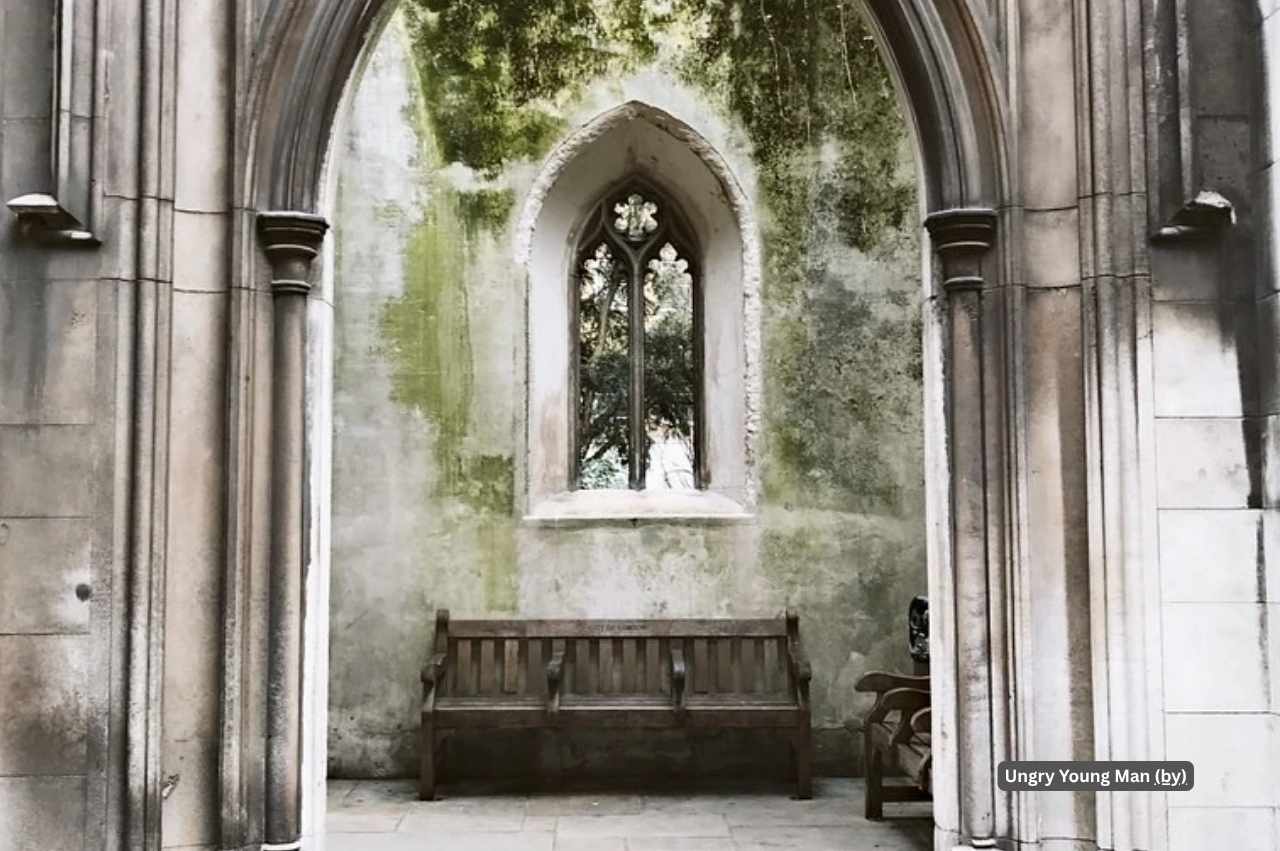
St Dunstan in the East is a ruined church on St Dunstan's Hill, a short walk from London Bridge. The original medieval church was damaged in the Great Fire of 1666; Wren was commissioned to add a tower and steeple, which survive. The rest of the church was rebuilt in the early 19th century, then bombed in the Blitz in 1941 and never restored. Since 1970, the roofless shell has been maintained as a public garden by the City of London Corporation.
The result is extraordinary: climbing plants cover the broken walls, the light comes through where the windows were, and the Wren steeple rises above the garden unharmed. It's a natural quiet spot in a part of London that doesn't offer many of those. Office workers eat lunch here; pigeons occupy the window arches; the whole place feels like an accident that turned out better than the original plan.
It's free, open daily, and genuinely one of the more atmospheric places in the Square Mile.
Did you know? St Dunstan in the East is one of several City of London churches that were never rebuilt after the Blitz - the City chose to preserve the ruins rather than restore them, and they've been maintained as gardens ever since. Samuel Pepys, the diarist who recorded the Great Fire in detail, worshipped at this church.
5. Postman's Park and the Watts Memorial

Postman's Park sits between St Martin Le Grand and Aldersgate Street, five minutes' walk from St Paul's Cathedral. It takes its name from the nearby workers at the old General Post Office who used it during lunch breaks. The park is small and easy to miss, and most people who walk past it keep walking.
The reason to stop is the Watts Memorial to Heroic Self Sacrifice - a long wooden loggia along the north wall, lined with hand-painted ceramic plaques, each one commemorating an ordinary person who died saving someone else. The memorial was the project of Victorian painter George Frederic Watts, who proposed it in 1887 as a counterpoint to the statues of generals and politicians that fill London's public spaces. The first plaques went up in 1900. They read simply: a name, a date, and what happened.
There's one for a woman who died pulling a child from a burning house. One for a clerk who was drowned trying to save a stranger. One for a boy who saved his sister but couldn't save himself. The language is Victorian in register but the stories aren't dated in any way that matters. It's worth reading all of them.
Did you know? Postman's Park and the Watts Memorial featured in the 2004 film Closer, directed by Mike Nichols, in which Natalie Portman's character reads the plaques. The film brought wider attention to the memorial, which had been largely unknown outside the City for most of its existence.
How to find the City's hidden layer with StoryHunt?
The hidden gems of the City of London are best understood in context - the Roman city, the medieval city, and the modern financial district are all there simultaneously, if you know where to look.
The StoryHunt app is free to download and lets you build a custom audio walk connecting these sites with the stories behind them. Download StoryHunt for Android and iOS here.







.avif)



.jpg)
.avif)


.avif)


