
.webp)


TLDR: Christianshavn is Copenhagen’s canal district, built by Christian IV in the 1600s as a Dutch-inspired merchant town. Highlights include the Church of Our Saviour’s spiral spire, Freetown Christiania, CopenHill, and amazing architecture. Less touristy, more charming.
Christianshavn feels like a separate town - which makes sense, because it was one. King Christian IV founded it in 1618 as a fortified merchant district on artificial islands, modelled on Amsterdam’s canal system.
As a local, I’d say this is where Copenhagen is at its most picturesque without trying too hard. The canals, the coloured houses, the houseboats; it's simply charming. And it’s a 10-minute walk from the city centre - but a world apart.
1. Church of Our Saviour (Vor Frelsers Kirke)

The Church of Our Saviour was completed in 1695, with the famous external spiral staircase added in 1752. Climbing the 400 steps takes you 86 metres up, with the last 150 winding around the outside of the golden spire.
The view is the best in Copenhagen.
But remember to book tickets in advance. Be aware that it closes in high winds. It's not for anyone with a fear of heights.
Did You Know? The tower’s carillon has 48 bells that play melodies over the neighbourhood daily.
2. Christianshavn Canal

The main canal running through the district is flanked by two streets: Overgaden Oven Vandet and Overgaden Neden Vandet. Walk either side for views of coloured townhouses, old warehouses, and houseboats.
This was once a commercial waterway for merchants and shipbuilders.
It’s one of the most photographed spots in Copenhagen, but quieter and more genuine than Nyhavn.
Did You Know? The street names translate to “Upper Street Above the Water” and “Upper Street Below the Water.”
3. Freetown Christiania
.jpg)
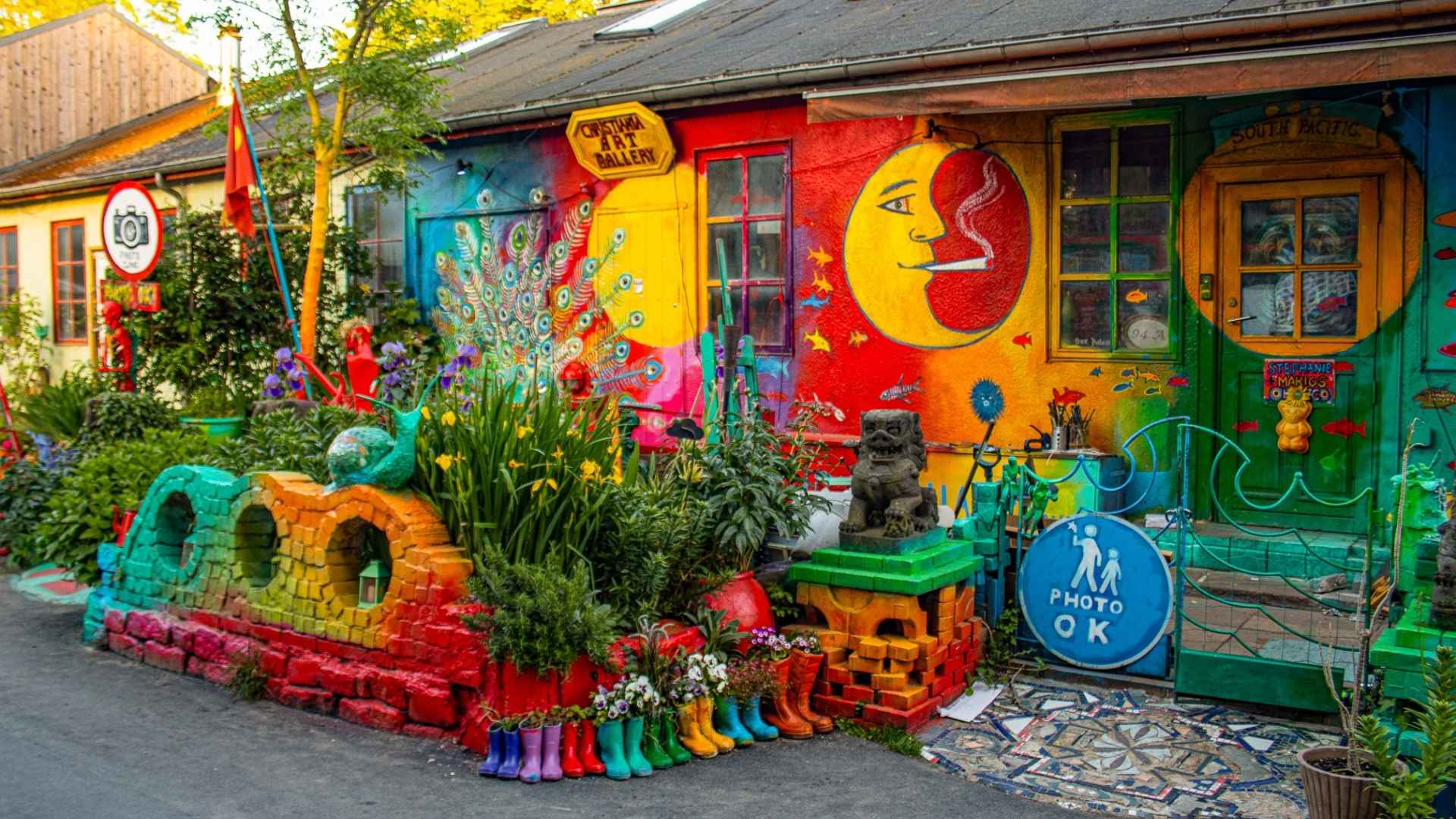
In 1971, squatters occupied these abandoned military barracks and declared a self-governing community. Christiania still operates with its own rules and attracts around half a million visitors annually. There are cafes, galleries, and handmade goods for sale.
Respect the no-photography signs. Even though a lot has been done to combat the illegal trade at Pusherstreet, some visitors still find some parts rough. It's totally worth visiting, though.
Did You Know? Christiania’s residents built many of the houses themselves, creating some of Copenhagen’s most unusual architecture.
4. Copenhagen Opera House

Even if you're not that into opera and classical music, The Copenhagen Opera House is still worth a visit. The architecture is stunning, and it is one of the world’s most modern opera houses.
You get a striking view across the harbor from this point, and if you dare enter the opera house, you'll also see some amazing design. You can take a guided tour inside, and something that's sure to stun you is the main auditorium; the ceiling is adorned with 105,000 sheets of 24-carat gold leaf, equivalent to about 1.5 kilograms of gold.
Did You Know? The Copenhagen Opera House was actually a gift to the Danish state from the owner of the shipping company Maersk.
5. Take a guided audio walk

Christianshavn’s history runs deep: merchant traders, military fortifications, squatter movements, and some of Denmark’s most innovative architecture. It is best explores with an audio guide, and with StoryHunt you can get tailored audio walks through the canal district with an interactive map - try it here.
Pick your interests and the app builds a route with narrated stories. It’s one of the best ways to understand how this neighbourhood became what it is.
Did You Know? Christianshavn sits on artificial islands created in the 1600s by filling in shallow waters between Zealand and Amager.
6. Cirkelbroen (The Circle Bridge)

The Circle Bridge is designed by artist Olafur Eliasson and it opened in 2015. This pedestrian bridge connects Christianshavn to the Applebys Plads area with five circular platforms with masts that create a shape inspired by the harbour’s maritime history.
It’s beautiful to walk across, especially in the evening. Free and always open.
Did You Know? Eliasson designed Cirkelbroen to slow people down and make them notice the water around them, rather than rushing across.
7. Danish Architecture Centre (BLOX)
%20in%20Copenhagen.jpg)
The view of the BLOX building from the harbour is grand. It's where the Danish Architecture Centre explores Denmark’s design and urban planning history through exhibitions and events. The building itself, designed by OMA, is worth seeing for its bold waterfront presence.
Good for a rainy day. The ground floor has a cafe and bookshop with harbour views.
Did You Know? BLOX also houses a fitness centre, apartments, offices, and a playground on its roof terrace.
8. CopenHill

CopenHill can be quite hard to describe. Is it a waste management center? Or is it a skiing slope? Well, the truth is, that it's both. The artificial skiing slope opened in fall 2019, and it was built on top of the new resource handling center.
If you bring your own ski or snowboard, you can save the rental fee, but a ski pass (lift ticket) is still required and costs DKK 150/hour.
Did You Know? Copenhagen is aiming to become the world’s first carbon-neutral capital.
Explore Christianshavn your way
Christianshavn is one of those neighbourhoods that gets better the more you know about it - and you can learn all about the neighborhood with our guide, which you can find here. The canals, the spire, the ramparts, the food; it all connects once you understand the 400 years of history packed into these small islands.
With StoryHunt you can create your own audio walk through Christianshavn with an interactive map. Available for iPhone and Android.




.jpg)


.avif)


.avif)


.avif)


.jpg)




.avif)


