
.webp)



TLDR: An iconic spiral designed by Frank Lloyd Wright, the Guggenheim Museum in New York City is a UNESCO World Heritage site offering a unique, often debated, modern art experience. Expect revolutionary architecture, significant Kandinsky works, and a different kind of art viewing journey.
I recently found myself captivated by the distinctive form of the Solomon R. Guggenheim Museum, a truly one-of-a-kind presence on New York's Fifth Avenue. This is a statement, a challenge, and an experience in itself.
If you're planning a trip to the Big Apple and wondering if this architectural marvel and its collections are for you, this article will guide you through what I saw, heard, and felt during my visit, offering practical insights to help you decide.
What is the story behind Guggenheim Museum?

The Guggenheim’s story began in the 1920s with mining magnate Solomon R. Guggenheim. He initially collected traditional art, but under the influence of artist Hilla von Rebay, his focus shifted dramatically to abstract works. Rebay envisioned a "temple of non-objectivity" to house this bold new collection, a concept that laid the foundation for the museum we see today.
This ambitious vision took concrete form with Frank Lloyd Wright’s revolutionary spiral design, a project that spanned 16 years. Completed in 1959, just months after Wright’s passing, the building itself defied convention. Its continuous, gently sloping ramp, said to be inspired by a nautilus shell, sparked controversy then but is now celebrated as a UNESCO World Heritage site. It fundamentally redefines how you move through and experience art, a dynamic flow you won't find anywhere else.
What makes the Guggenheim museum in New York unique?
What immediately strikes you is the Guggenheim’s truly groundbreaking architecture. Frank Lloyd Wright’s design stands apart from anything else in Manhattan. Its most distinctive feature is the continuous, gently sloped spiral ramp that winds upward around an open central atrium. This creates an immersive experience; you take an elevator to the top and then descend gradually, viewing art without ever having to retrace your steps.
The building, a modern architectural masterpiece and a UNESCO site, deliberately contrasts with Manhattan's straight-laced grid with its organic, curving form. I spotted a small red tile on the exterior bearing Frank Lloyd Wright’s initials, a subtle nod to his pride in this monumental creation.
What is the Guggenheim Museum famous for?

The Guggenheim Museum is undeniably most famous for its extraordinary architecture. Frank Lloyd Wright’s iconic spiraling concrete structure, often compared to a nautilus shell, isn't just a building; it’s a work of art in itself and a UNESCO World Heritage site. As you walk its quarter-mile ramp, you experience art in an uninterrupted, flowing sequence, a truly revolutionary approach.
Beyond this architectural marvel, the museum houses a significant collection of modern and contemporary art. You'll find pivotal works by artists like Wassily Kandinsky – indeed, the largest collection anywhere – alongside pieces by Pablo Picasso and others. It's fascinating to think that when it first opened in 1959, critics scoffed, likening it to an "inverted oatmeal bowl." Yet, this bold vision has transformed into a globally recognized and beloved landmark.
Why is the Guggenheim museum controversial?
From its very beginnings, the Guggenheim has stirred debate, primarily due to its radical architecture. When it first opened, many artists and critics argued that Wright's sloped walls and curved spaces were ill-suited for displaying art. They felt the building often overshadowed the artworks themselves, a point some visitors still raise today.
More recently, the museum has faced other kinds of scrutiny. In 2017, planned exhibitions featuring controversial artworks depicting animal cruelty were removed after widespread protests. There have also been concerns raised about labor practices related to the Guggenheim Abu Dhabi project and broader issues of racial inequity within the institution. These incidents highlight ongoing discussions about the museum's curatorial choices and its responsibilities beyond its walls.
Did Frank Lloyd Wright build the Guggenheim Museum?

Yes, Frank Lloyd Wright, the renowned architect, absolutely designed the iconic Solomon R. Guggenheim Museum in New York City. He received the commission in 1943, and it became a monumental undertaking that spanned 16 years. Poignantly, the museum was finally completed in 1959, just six months after Wright's passing, making it his last major project.
As you explore, you'll feel how the museum’s distinctive spiraling rotunda perfectly embodies Wright's philosophy of "organic architecture." He aimed to integrate the building with its purpose and environment, creating a fluid, immersive way for you to engage with art.
The building itself is a masterpiece of modern design and a UNESCO World Heritage Site, with its bold curves providing a dramatic contrast to Manhattan's structured grid. You might even spot his initials, "FLW," etched into a small red tile on the exterior, a testament to his personal oversight.
How many Guggenheim museums are there?
Currently, there are three active Guggenheim museums around the world, each with its own distinct character. The one here in New York City, designed by Frank Lloyd Wright, is the original and a UNESCO World Heritage Site, instantly recognizable for its unique spiral.
Then there's the Guggenheim Museum Bilbao in Spain, equally famous for its shimmering titanium exterior by Frank Gehry, making the building itself an incredible sculptural artwork. And in Venice, Italy, you'll find the Peggy Guggenheim Collection, offering a more intimate experience within the former residence of Solomon R. Guggenheim's adventurous niece, Peggy.
Additionally, a fourth institution, the Guggenheim Abu Dhabi, is currently under development, promising another architectural spectacle.
Is it worth visiting Guggenheim Museum?
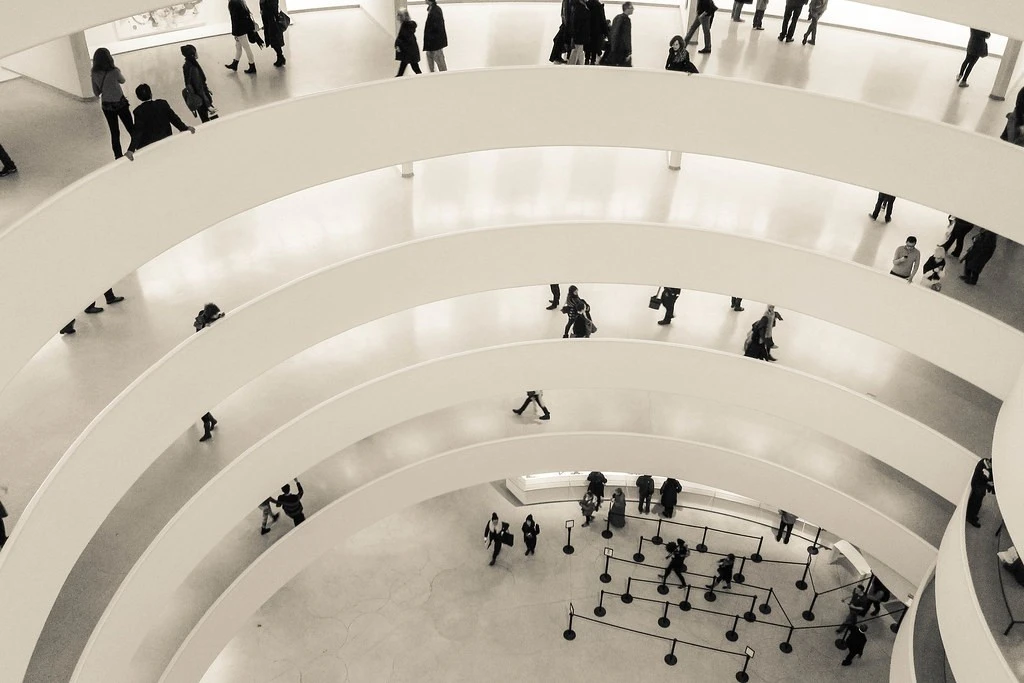
Visiting the Guggenheim offers a truly distinct art experience, largely defined by Frank Lloyd Wright’s iconic building, which is a UNESCO World Heritage site. Walking up or down its spiraling rotunda is an attraction in itself, a sculptural journey that sets it apart. The museum houses a significant collection of modern and contemporary art, including key works by Kandinsky, Picasso, and Van Gogh, often complemented by compelling special exhibitions.
However, its unique design isn't for everyone. Some visitors, myself included at times, find the architecture can occasionally overshadow the art. The slanted walls and curved spaces can feel a bit disorienting, and the permanent collection, while important, might not seem as extensive or diverse compared to other major museums.
It can also get quite crowded and noisy, especially on weekends. To avoid the busiest times, aim for weekdays, either right at opening around 11 AM or later in the afternoon around 4 PM. Architecture enthusiasts and modern art lovers will likely appreciate it most for its groundbreaking design.
General admission is around $30, with discounts available. Plan for about 1.5 to 4 hours. If you’re unsure how to fit it into your trip, you can use StoryHunt to help prioritize what to see in New York.
What else can I do in New York?
After experiencing the unique architecture and art at the Guggenheim Museum, you'll find yourself in a fantastic location in Upper East Side with plenty more to explore. Just a short walk south along Museum Mile is the Metropolitan Museum of Art (The Met), an absolute treasure trove spanning 5,000 years of global culture, offering a stark contrast to the Guggenheim's modern focus.
Right on the Guggenheim's doorstep is the vast green expanse of Central Park. Take a leisurely stroll, rent a rowboat on The Lake, or simply find a bench and people-watch. For a quieter, more local feel, wander through the charming side streets of the Upper East Side, admiring the elegant brownstones and boutique shops.
To truly get a sense of New York’s many layers and uncover both famous landmarks and hidden gems, consider using The Personal Tour Guide; its audio stories can be your personal guide, enhancing your exploration at your own pace.

















.jpg)

.jpg)















.jpg)





.jpg)















.avif)


